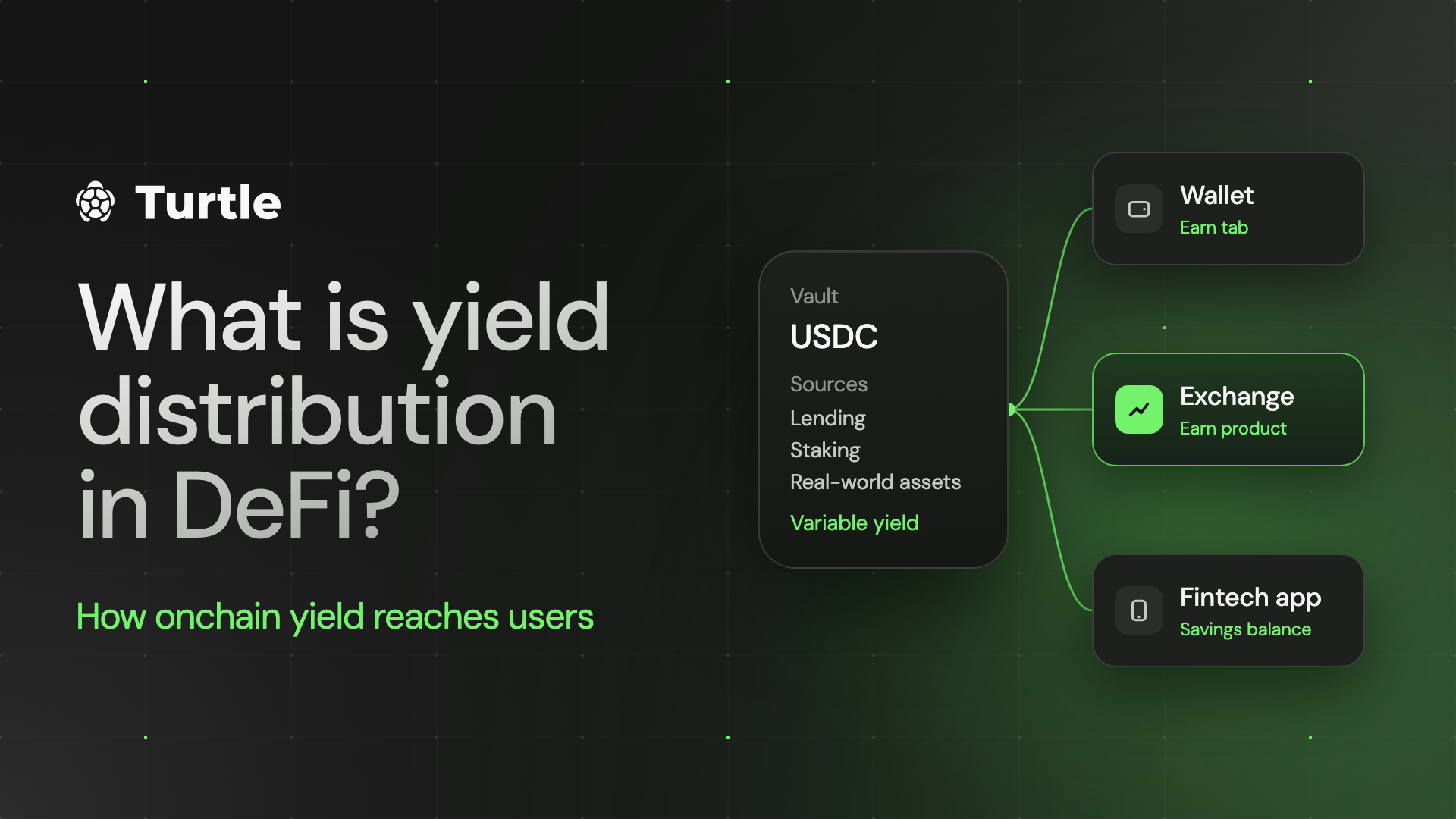

Yield distribution in DeFi is the process that carries onchain yield from where it is created, such as lending markets, staking and vaults, to the people who earn it, usually through the wallets, exchanges and fintech apps they already use. A protocol produces the return, a curator or vault packages it, a distributor puts it in front of users, and each deposit is tracked so every party can be paid for its role.
In traditional finance, "distribution yield" means something else: the cash a fund such as an ETF pays out relative to its price. This guide covers the DeFi meaning: where onchain yield comes from, how it reaches end users, who does what, how revenue is shared and what users should be told before they deposit.
Where does onchain yield come from?
Every onchain return is paid by someone. These are the main sources:
| Source | Who pays the yield | Example | Main risk |
|---|---|---|---|
| Lending | Borrowers paying interest | Supplying USDC to a lending market | Bad debt, smart contract bugs |
| Staking | The network, for securing it | Staking ETH to run or back a validator | Slashing, lockups, token price |
| Basis and funding | Traders paying to hold leveraged long positions | Delta-neutral synthetic dollars | Funding turning negative, exchange risk |
| Real-world assets | Issuers of short-term debt, such as government bills | Tokenized treasury funds | Issuer and custody risk, transfer limits |
| Trading fees | Traders swapping on a DEX | Providing liquidity to a pool | Impermanent loss |
| Incentives | A protocol's treasury | Token or points rewards on top of a vault | Rewards end, reward token price |
On Aave, supplying assets "lets users earn interest" from borrowers (Aave docs). On Ethereum, stakers earn rewards for securing the network, and provable misbehavior is punished by slashing (ethereum.org). Basis strategies pair a crypto asset with a matching short derivatives position and collect the funding rate; Ethena lists funding and basis, lending and tokenized real-world assets among its revenue sources (Ethena docs). Tokenized funds bring instruments such as bonds onchain (ethereum.org).
Rates from every source move with market conditions, so any yield an app shows is variable. Turtle explains how those rates are quoted in APY vs APR in crypto.
What is the distribution layer in DeFi?
The distribution layer is everything between a yield source and the person who deposits. Many users never open a lending market's interface. They hold stablecoins or ETH in a wallet, an exchange account or a fintech app, and that app is where they look for a return.
Distributors are the platforms that make the connection:
- Wallets that show an earn tab next to the user's balance.
- Exchanges that let users move funds into onchain vaults.
- Fintech apps and neobanks that offer an interest-earning balance powered by DeFi, a model known as embedded finance.
- Communities, newsletters and creators that share vetted opportunities with their audience.

Protocols build for this: Aave offers developer kits for wallets, exchanges and fintech platforms (Aave docs). Standards help too. ERC-4626 gives yield-bearing vaults one common interface, which lowers "the integration effort" for apps that want to offer yield (ethereum.org).
Who does what in yield distribution?
Yield distribution has five roles. One company can play more than one of them.
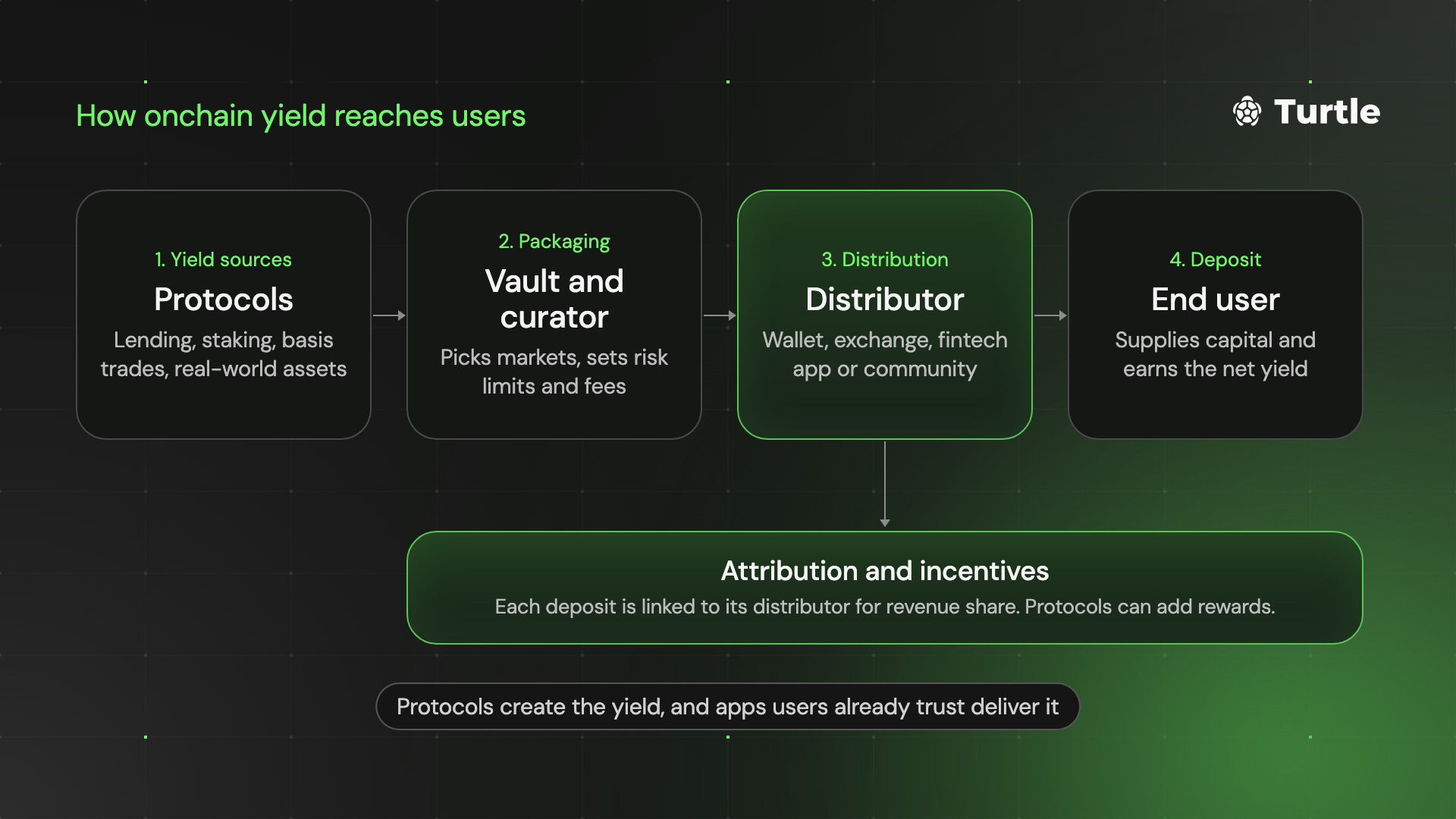
 Protocols create the yield, and it reaches users through the platforms they already use.
| Role | Who it is | What it does | How it earns |
|---|---|---|---|
| Protocol | Lending market, staking protocol, DEX, issuer | Creates the underlying return | Its own fees and spreads |
| Curator or vault | Vault manager or risk curator | Picks markets, sets risk limits, allocates deposits | Performance and management fees |
| Distribution infrastructure | API or SDK provider | Lists opportunities, builds transactions, attributes deposits | Fees from protocols or a share of yield |
| Distributor | Wallet, exchange, fintech app, community | Owns the user and the deposit screen | Revenue share on the deposits it brings |
| End user | The depositor | Supplies the capital and takes the risk | The net yield, plus any incentives |
Curators make the risk decisions users rarely see. Morpho describes a curator as the entity that "configures vault risk parameters and liquidity allocation rules", including exposure caps and fees (Morpho docs). Turtle's guide to how crypto vaults work covers what happens inside a vault.
How does a deposit move from an app to a vault?
A distributed deposit follows the same basic path in most setups:
- The distributor picks opportunities that fit its audience, for example stablecoin vaults on one chain.
- The user deposits in the app, which shows the vault, its variable rate and its terms, and builds the transaction.
- The assets go into the vault. In a self-custodial setup, the user signs from their own wallet.
- The deposit is attributed. An identifier links it to the distributor that sourced it.
- Yield accrues, with any incentives paid on top.
- The user withdraws. Some vaults settle withdrawals at once, and others queue them.
Attribution is the step that makes the model pay. Without proof of which deposits a distributor brought, it cannot be paid for them, and protocols cannot measure what their incentives bought.
How is revenue shared in yield distribution?
Each layer takes a share of the value it adds. The common pieces are:
- The protocol keeps its own fees, such as a share of borrower interest.
- The curator charges a performance fee on yield, a management fee on assets, or both.
- The distributor earns revenue share on the deposits it brings, for as long as they stay. Depending on the deal, this is paid from the yield, from a protocol's budget or from both.
- A protocol running a campaign may fund extra incentives on top of the vault's yield.
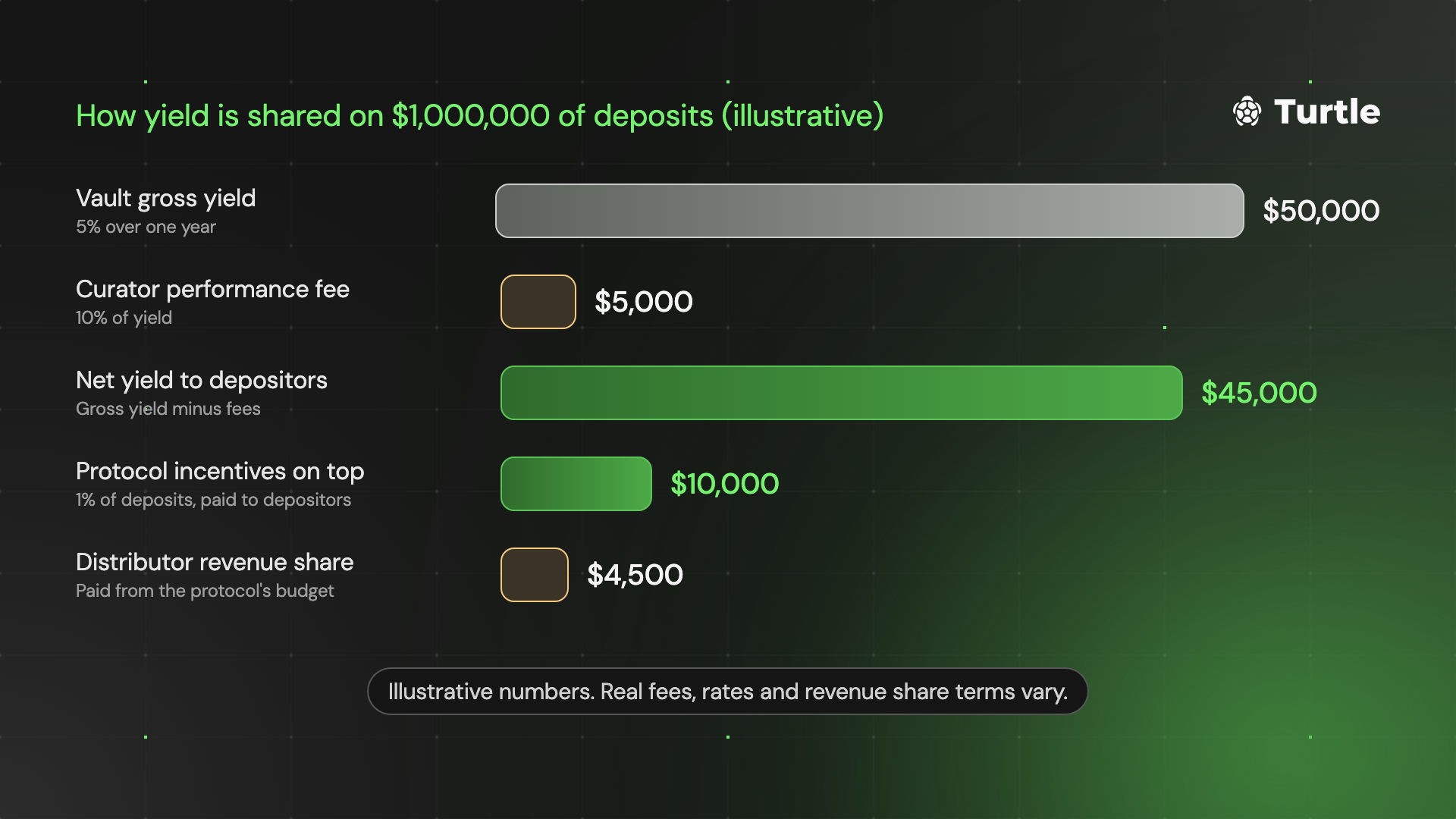
Here is an illustrative example. All numbers are made up to show the math, and real rates vary.
| Item | Value |
|---|---|
| Deposits brought by a wallet | $1,000,000 |
| Vault gross yield over one year (5%) | $50,000 |
| Curator performance fee (10% of yield) | $5,000 |
| Net yield to depositors | $45,000 |
| Protocol incentives on top (1% of deposits) | $10,000 |
| Distributor revenue share, paid from the protocol's budget (10% of net yield) | $4,500 |
 An illustrative split. Real fees, rates and revenue share terms differ by vault and agreement.
Protocols pay for distribution to reach users who already hold balances in apps they trust. Capital that arrives only for short-term rewards tends to leave when they end, a pattern known as mercenary capital. Paying distributors on deposits that stay links their income to TVL that lasts.
What risks and disclosures come with distributed yield?
A distributor puts its brand next to someone else's smart contracts. The main risks are:
- Smart contract risk. A bug or exploit in a vault or protocol can cause losses. Audits reduce this risk without removing it.
- Curator and strategy risk. The return depends on how the curator allocates deposits and handles market stress.
- Source risk. Bad debt in lending, slashing in staking, negative funding in basis trades, issuer risk in real-world assets.
- Liquidity risk. Some vaults queue withdrawals, so users may wait to get funds back.
- Custody risk. In a custodial app, users depend on the platform holding their assets.
- Regulatory risk. Rules for crypto yield and stablecoins differ by country and change over time, so every platform needs its own legal review.
Before a user deposits, a well-built yield screen shows:
- Where the yield comes from, in plain words.
- That the rate is variable, and which part comes from incentives that will end.
- The fees taken by the vault and anyone else in the chain.
- Who holds custody of the funds.
- Withdrawal terms, including any queue or lockup.
- How the opportunity was reviewed, with links to audits or diligence reports.
How does Turtle connect yield sources with distributors?
Turtle is a distribution protocol for DeFi yield that connects three sides: yield opportunities, distributors such as wallets, exchanges and neobanks, and protocols that want liquidity. "Distributors bring the users, protocols fund the incentives, and liquidity providers earn the yield" (Turtle docs).
Turtle's Distribution product lets a platform put vetted opportunities in front of its users and earn on the deposits they bring in (Turtle docs). Based on Turtle's documentation:
- Two ways to integrate. Share links need no code and work with Turtle featured deals. The Earn API lets a wallet or app build deposits into its own interface and covers the full catalog.
- Attribution onchain. Every deposit carries the distributor's ID in its calldata, and Turtle attributes it automatically, with no manual reporting (Turtle docs).
- Revenue share on attributed TVL. Distributors earn recurring revenue share on the TVL they bring, for as long as that TVL stays. Rates are set per distributor (Turtle docs), and payouts release automatically from the deal's escrow wallet.
- Selected opportunities. Opportunities on Turtle are not self-listed, and every Liquidity Campaign goes through the Turtle Due Diligence Council before it goes live.
- Users keep custody. Turtle generates an unsigned transaction, the user signs it from their own wallet and the assets go into the vault contract they chose (Turtle docs).
Distribution opportunities span chains including Ethereum, Base, Arbitrum, Avalanche, BSC, Optimism, Polygon, Linea and Scroll.
If you run a wallet, exchange, fintech app or community and want to offer onchain yield to your users, start with Turtle Distribution and the steps to become a distributor.
FAQ
What does yield distribution mean in crypto?
It is the path that takes yield created onchain, in lending, staking, basis trades or tokenized assets, to end users through wallets, exchanges and fintech apps, with each deposit tracked so every party is paid.
What is the difference between yield distribution and distribution yield?
Distribution yield is a traditional finance metric: the cash a fund pays out relative to its price or net asset value. Yield distribution in DeFi describes how onchain returns reach users through distributors.
Who is a yield distributor?
Any platform that puts yield opportunities in front of users and is credited for the deposits it brings, such as a wallet, exchange, neobank, fintech app or community.
How do distributors earn from DeFi yield?
Most earn revenue share on the deposits they bring, measured on the TVL attributed to them. The share can come from the yield itself, from a protocol's incentive budget or from both, depending on the agreement.
Is distributed DeFi yield guaranteed?
No. Onchain yield is variable and carries smart contract, strategy, liquidity and regulatory risk. Check the yield source, fees, custody model and withdrawal terms before you deposit.
Do users give up custody when they earn yield through an app?
It depends on the app. In a self-custodial setup, the user signs each transaction and the assets go straight into the vault contract. In a custodial app, the platform holds the assets and deposits for the user.