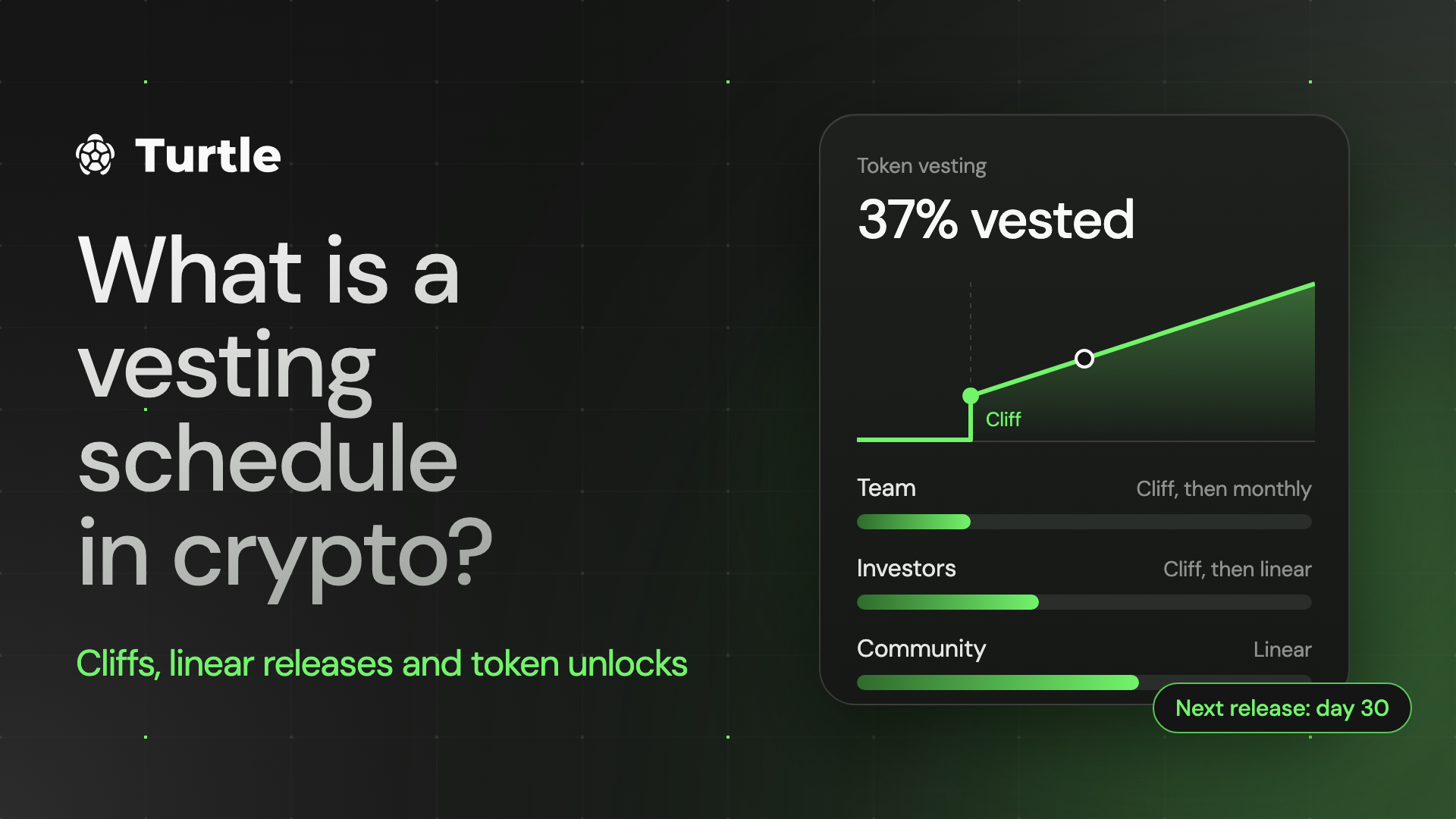

A vesting schedule in crypto is the timetable that decides when locked tokens become free for their owner to move, sell or stake. Most schedules start with a cliff, a waiting period with no releases, followed by regular releases until every token has vested. Projects use them for team, investor and community allocations, and more and more for user rewards.
The term comes from employee pay, where stock options and retirement plan contributions vest over years of service. In crypto, a smart contract usually holds the tokens and releases them on the agreed dates. This guide covers the types of schedules, cliffs, token unlocks, reward vesting and how to read a schedule.
What does vesting mean in crypto?
When a project creates its token, it splits the supply between the team, investors, a treasury, the community and incentive programs. Vesting controls when each group can use its share.
Tokens vest when the owner earns the right to them and unlock when they become free to move. Most token documents use both words for the same timetable.
Vesting is usually enforced in code. A vesting contract holds the tokens and lets the recipient withdraw only what has vested so far. Sablier, an onchain vesting protocol, describes the cliff this way: "Prior to the cliff, the recipient cannot withdraw any tokens, but the stream continues to accrue them" (Sablier docs).
Vesting serves two goals. It ties insiders to the project for several years, and it spreads the arrival of new supply over time.
What are the main types of vesting schedules?
Most crypto schedules combine a few building blocks.
| Type | How tokens are released | Common use |
|---|---|---|
| Cliff then linear | Nothing until the cliff, then equal amounts each month, day or second | Team and investor allocations |
| Linear | A steady release from day one, often second by second | Foundations, grants, contributor pay |
| Graded (tranched) | Fixed portions on set dates, such as every quarter | Investor rounds, milestone grants |
| Upfront release plus linear | A share at the token launch, the rest released over time | Airdrops, public sale buyers |
| Cliff only | Everything at one date | Short lockups, reward tiers |
| Immediate | Free at the token launch | Liquidity and exchange reserves |
In Sablier's linear shape, "the same fraction of the deposit amount is released to the recipient every second" (Sablier docs).
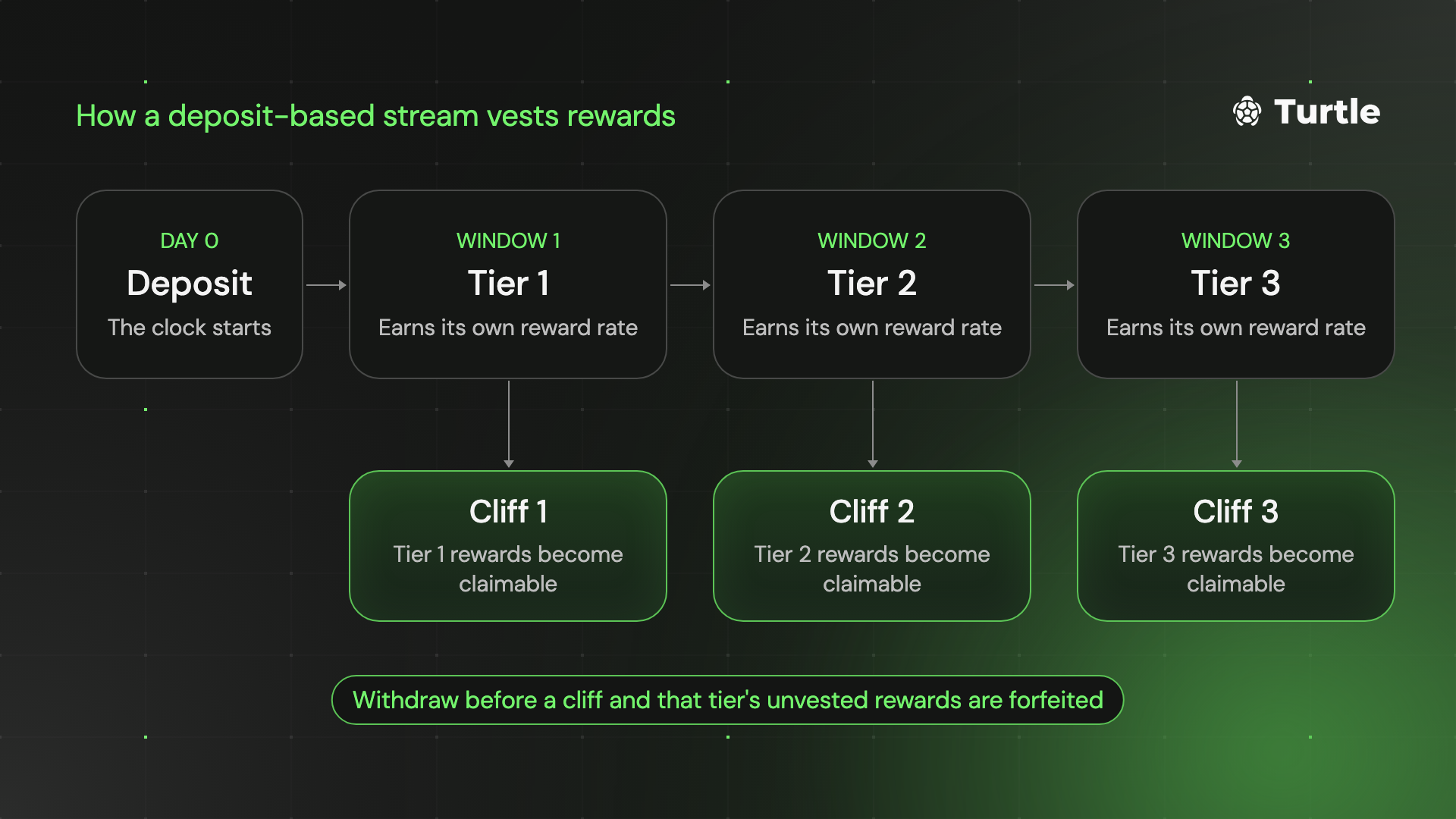 Three common vesting shapes. Illustrative schedules.
How does a vesting cliff work?
A vesting cliff is the waiting period before the first tokens vest. If a recipient leaves or a condition fails before the cliff, they usually receive nothing from that allocation. After the cliff, the schedule starts releasing tokens.
Schedules handle the cliff date in two ways. Some release everything that accrued during the cliff at once, so a one-year cliff on a four-year schedule frees 25% on the first anniversary. Others start the monthly releases at the cliff and free nothing on the cliff day. The token documents or the vesting contract tell you which one applies.
Here is an illustrative example of the first kind. The numbers are made up to show the math: a grant of 4,800 tokens vesting over 48 months, with a 12-month cliff and monthly releases afterward.
| Month | Released this month | Total vested |
|---|---|---|
| 0 to 11 | 0 | 0 (0%) |
| 12 (cliff) | 1,200 | 1,200 (25%) |
| 13 | 100 | 1,300 (27%) |
| 24 | 100 | 2,400 (50%) |
| 36 | 100 | 3,600 (75%) |
| 48 | 100 | 4,800 (100%) |
What do real token vesting schedules look like?
Projects publish their schedules in their token documents. Two examples from primary sources:
| Token | Group | Share of supply | Cliff | Vesting |
|---|---|---|---|---|
| TURTLE (Turtle) | Team, advisors and contributors | 23.10% | 12 months | 36 months linear |
| TURTLE (Turtle) | Private rounds (investors) | 27.50% | 6 months | 36 months linear |
| TURTLE (Turtle) | Liquidity, market making and exchange reserves | 8.00% | None | Released at the token launch |
| ARB (Arbitrum) | Team, contributors and advisors | 26.94% | First release one year after launch | Monthly for the remaining three years |
| ARB (Arbitrum) | Investors | 17.53% | First release one year after launch | Monthly for the remaining three years |
TURTLE is Turtle's own token, and its documentation notes the allocation is subject to change at the close of the latest investment round (Turtle docs). Arbitrum's documentation states that "all investor and team tokens are subject to 4 year lockups, with the first unlocks happening one year after the token generation event" and monthly unlocks for the following three years (Arbitrum Foundation docs).
What is a token unlock, and how does it affect supply?
A token unlock is the date when a batch of vested tokens becomes free to move. Each unlock raises the circulating supply, the number of tokens available to the market. Since the dates are public, large unlocks can be tracked in advance. Check three things:
- Size. Compare the unlock with the current circulating supply. An unlock equal to 1% of circulating supply adds little, and one equal to 20% adds a lot.
- Recipients. Team members and early investors often received tokens at a lower cost than later buyers. Ecosystem and community allocations usually go to grants and incentive programs.
- Pace. A cliff release adds supply on a single day. A linear release adds a similar amount every day or month.

Demand, staking, buybacks or new uses for the token can absorb new supply, and an unlock calendar shows only when tokens can move. Turtle's guide to how to design a liquidity mining campaign covers how incentive emissions add to this supply.
How does vesting work for user rewards?
Vesting also applies to users. Protocols pay rewards to liquidity providers, depositors and airdrop recipients, and many of those rewards vest over time. Deposits that arrive for short-term rewards and leave when they end are known as mercenary capital, and reward vesting is one way to counter it.
Reward vesting often comes with forfeiture: a user who leaves early, or claims before the schedule ends, gives up the part that has not vested. Turtle's Genesis Airdrop shows how this works (Turtle docs):
- Allocations of 1,700 TURTLE or less were fully released at the token launch, with no vesting.
- For larger allocations, 70% was claimable at the token launch and the remaining 30% vested linearly over 12 weeks.
- Each wallet could claim only once. A claim forfeited any unvested tokens, which were returned to the treasury or burned.
- A wallet that claimed after four weeks received about 80% (70% upfront plus 10% vested) and forfeited 20%. A wallet that waited 12 weeks received 100%.
Team and reward vesting share the same mechanics: a cliff, a release pace and rules for leaving early. Team and investor schedules usually run for years, and reward schedules for days, weeks or months.
How do you read a vesting schedule?
Find the token's allocation table, usually in the project's documentation under tokenomics, and work through these questions:
- Who gets what? List each group and its share of the supply.
- When does the clock start? Most schedules start at the token generation event (TGE), the token's launch date. Some start at a later date.
- How long is the cliff? Note whether the cliff date releases a lump sum or only starts the monthly releases.
- How fast is the release? Check the total vesting period and the frequency: per second, per day, per month or per quarter.
- When is the next large unlock? Compare it with the current circulating supply.
- Is it enforced onchain? Look for the vesting contract addresses, which anyone can check.
- Can it change? Some documents note that allocations may change. For rewards, read the forfeiture and claim rules before you deposit.
How does Turtle Streams pay rewards on a vesting schedule?
Turtle Streams is Turtle's self-serve incentive distribution product. A protocol creates a stream that pays tokens or points to liquidity providers based on their contribution to a vault, a pool or another position (Turtle docs). Two of its reward types map to the schedules above.
TVL-based streams pay continuously. Holders earn against their balance as long as they hold it. Turtle commits the latest rewards onchain as a Merkle root roughly every 12 hours, and each commit makes newly accrued rewards claimable.
Deposit-based streams vest rewards with cliffs. The protocol sets duration tiers, each a holding period with its own reward rate. The tiers run in series from each deposit's arrival, and each tier's rewards become claimable at its cliff, the end of that tier's window. Turtle's documentation states that "withdrawing before a cliff forfeits that tier's unvested rewards" (Turtle docs). A team can set a first tier that pays nothing and later tiers that pay more, so rewards go to depositors who stay longest.
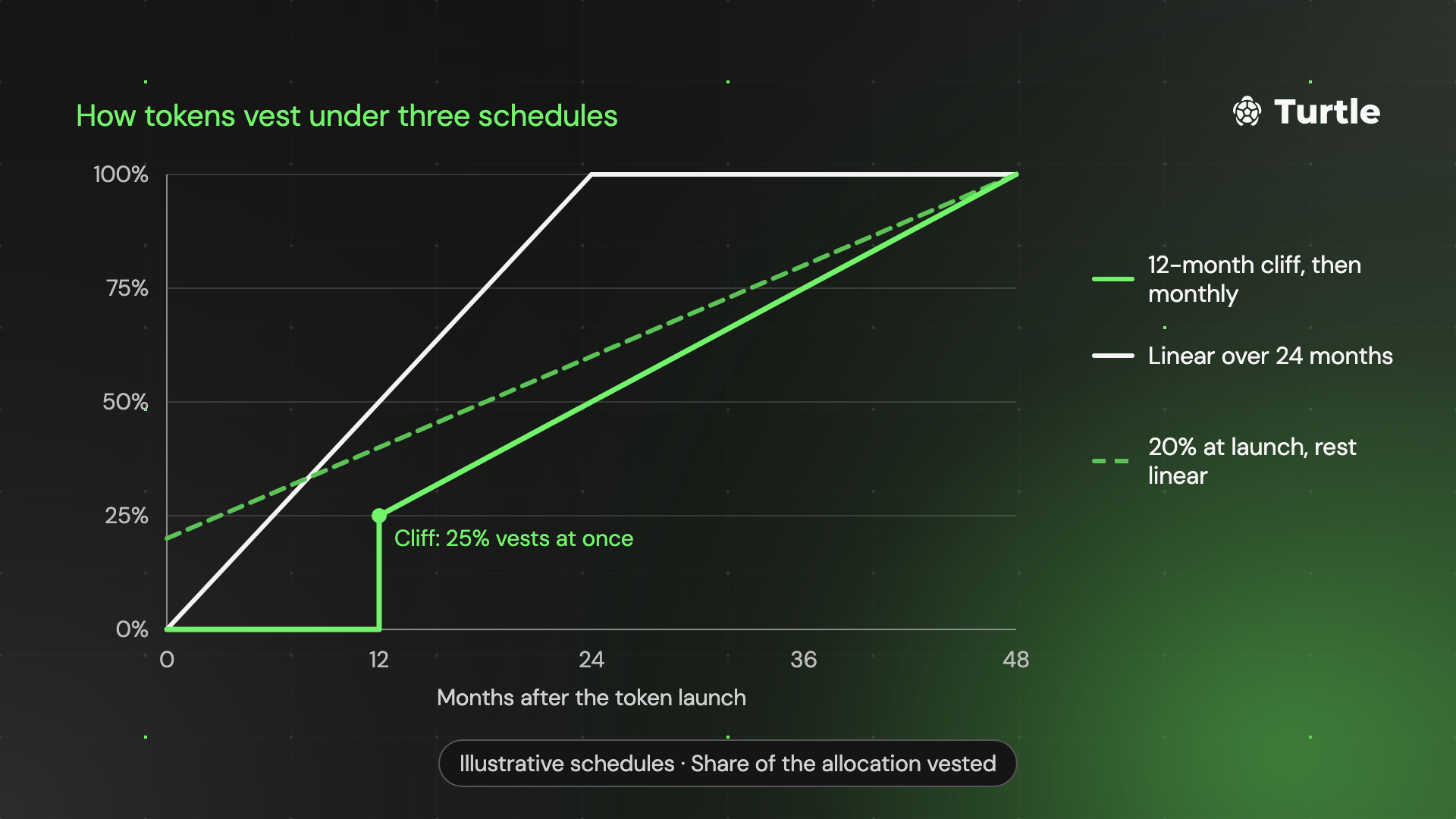 In a deposit-based stream, each tier's rewards vest at its cliff.
A few rules apply to every stream:
- Claims are cumulative. One claim pays the full outstanding balance, so LPs can claim on their own schedule (Turtle docs).
- Vesting rewards are visible. In the Turtle app, deposit-based rewards that have not reached a cliff appear under Vesting Rewards in Portfolio, Earnings.
- LPs keep custody. Streams puts no lockup on the LP's position, and LPs keep custody of it throughout. Each stream holds its own funds in a separate contract, and the contracts were audited in January 2026.
- The budget is funded upfront. A stream's total amount and duration are fixed at creation, and the stream is fully collateralized from the start (Turtle docs).
If you want to reward liquidity that stays, you can start a stream at streams.turtle.xyz.
FAQ
What is the difference between vesting and unlocking?
Vesting is the process of earning the right to tokens over time. Unlocking is the moment vested tokens become free to move. Most token documents use the two words for the same timetable.
What does a one-year cliff mean in crypto?
It means no tokens vest during the first year. On the cliff date, the schedule either releases the share that accrued during that year or starts its regular releases. A common pattern is a one-year cliff followed by monthly releases for three more years.
What happens to unvested tokens if someone leaves early?
It depends on the rules. In employee and contributor grants, unvested tokens usually return to the project. In reward programs, early withdrawal or an early claim can forfeit the unvested part, as in Turtle's Genesis Airdrop and deposit-based Turtle Streams.
Can a vesting schedule change?
It can, if the documents allow it or governance votes to change it. Schedules enforced by an onchain contract follow the contract's terms, so check both the documentation and the contract.
Is vesting the same as staking?
No. Vesting controls when tokens assigned to you become yours to use. Staking is a choice to lock tokens you already hold, usually to earn rewards or secure a network.